
Posted in School Projects, Wildlife, tagged big garden birdwatch, big schools’ birdwatch, bird feeding, bird survey, bird watching, family birdwatching, feed the birds in winter, feeding garden birds, guide to feeding birds, high energy bird food, RSPB Big Garden Birdwatch, RSPB Big Schools Birdwatch, school bird watching, school wildlife, what to feed birds, wildlife education on January 22, 2016| Leave a Comment »

This year the RSPB’s Big Garden Birdwatch takes place on the weekend of 30th/31st January, it began in 1979 and is now one of the world’s largest wildlife surveys, last year 585,000 people took part and counted 8,546,845 birds. Each year the results are collated and are used to compare trends, monitor species, understand how birds are doing and take steps to put things right.
Here are last year’s (2015) top 10 birds
- House Sparrow
- Starling
- Blackbird
- Blue Tit
- Woodpigeon
- Chaffinch
- Robin
- Great Tit
- Gold Finch
- Collared Dove
In 2014 the House Sparrow also came top, and the same bird species were in the top 10 although some in a different position. Each year there are mixed results here are some winners and losers from 2015’s survey.
The Winners
- The Blackbird was the most widely spotted bird in your gardens, they were spotted in more than 90 per cent of your gardens in 2015.
- Robins have climbed three places to the number seven spot, in 2014 they were number 10, but just over 85 per cent of you saw them in 2015.
- Twice as many people saw Wrens in their garden in 2015 than in 2014, they were spotted by 35 per cent of you, the highest number since 2006.
The Losers
- Song Thrush sightings have declined again, an all-time low, they are currently in 22nd place, and like many of our favourite garden birds they remain on the red list.
- Greenfinches dropped dramatically to 25th place, the drop is likely due to Trichomonosis disease. You can help to fight this disease by giving your feeders, bird tables and bird baths a regular clean.
- Starling numbers have plummeted by 80% since the first RSPB Birdwatch in 1979, another red-listed species, the RSPB is urgently researching the reasons for their decline.
There are many birds on the red list which are familiar to us; it is hard to believe that they are in decline and in trouble here are some of them:
- Curlew
- Black Grouse
- Woodcock
- Starling
- Puffin
- Hen Harrier
- Herring Gull
- Turtle Dove
- Willow Tit
- Marsh Tit
- Skylark
- Fieldfare
- Song Thrush
- Cuckoo
- House Sparrow
- Redwing
- Mistle Thrush
- Nightingale
- Tree Sparrow
- Greenfinch
There is one bird mentioned above that you might think is listed by mistake, its the House Sparrow although it was top of the RSPB Birdwatch list for the last two years its numbers are still in decline, between 1977 and 2008 the House Sparrow population dramatically dropped by 71%.
All the birds that you spot this year are very important, and just as important are the birds that you don’t spot.
Take part in this year’s RSPB’s Big Garden Birdwatch – it’s lots of fun, educational and a great family activity. Schools can get involved too and take part in the RSPB Big Schools’ Birdwatch any day/time this term until 12th February for more details and to sign up visit the RSPB’s website.
If you want more information on Feeding Garden Birds click here to have a look at our guide.
Have a fabulous Bird Watching Weekend.
Gill
Read Full Post »
Posted in Seasonal Celebrations, Wildlife, tagged bird watching, bird watching events, dawn chorus events, identifying bird songs, identifying birds, International Dawn Chorus Day, Listening to bird song, the dawn chorus, the dawn chorus in the uk on April 30, 2015| Leave a Comment »
This Sunday it’s International Dawn Chorus Day (3rd May 2015) so why not get up really early in fact at least an hour before sunrise and you will be rewarded with one of natures finest events – The Dawn Chorus, the best time to listen is between late April and early June this is when you will hear the most species singing. Birds will start to sing an hour before sunrise peaking half an hour before and half an hour after sunrise, birds seem to take it in turns to sing, some of the first birds to sing are Blackbirds, Song Thrush, Robins followed by Finches, Dunnocks and Sparrows and then the smaller birds such as Wrens and Warblers.
So why do birds sing?
The main reasons for singing in Spring are to:
- Claim and guard a territory – They tell other birds that their patch is occupied and that a territory exists.
- Attract a mate – The stronger and better their song is, the more likely they are to be a good partner and attract a mate.
Birds can make different calls which can either be to indicate a source of food, keep their flock together or to warn of danger from predators.

Some birds such as Great Tits and Blue Tits have more than one song which can be confusing, if you are new to bird watching and not familiar with identifying birds songs there are many organised events taking place on Sunday and throughout May, you can go on a guided walk with an expert who will help you to identify the birds that you hear. It can be quite chilly so early in the morning, wear plenty of warm and waterproof clothes, take a hot drink, a note pad and your binoculars or camera; some events have breakfast included!
A word of caution some birds are very talented and can mimic the songs of other birds, one such bird is the Starling. We have Starlings at home that sit on the gutter and sing their little hearts out, they do sing their own song but they are also very good at imitating a Curlew, Lapwing, Heron, Gull, Sparrow and a Hen, they really are amazing.
It really is worth the effort getting up early on Sunday to listen to the Dawn Chorus, you can always have a lie in the day after – it’s a Bank Holiday.
Have fun
Gill
Read Full Post »
Posted in Competitions, School Projects, Wildlife, tagged big garden birdwatch, big schools’ birdwatch, bird feeding, bird watching, family birdwatching, feed the birds in winter, feeding garden birds, free bird competition, guide to feeding birds, high energy bird food, school bird watching, school wildlife, what to feed birds, wildlife education, Win bird feeders, win nest boxes, win school competition prizes, win wildlife products on January 19, 2015| Leave a Comment »

A Wooden Peanut Butter Feeder provides a high energy treat for the birds
This weekend (24th/25th January) is the RSPB’s Big Garden Birdwatch it began in 1979 and is one of the world’s largest wildlife surveys, last year nearly half a million people took part with 7,274,159 birds being counted. Each year the results are collated and are used to compare trends, monitor species, understand how birds are doing and take steps to put things right.
Schools are also invited to take part, they can do the Big Schools Birdwatch anytime this half term until the 13th February, and can Register and download specially designed classroom resources on the RSPB website.
How do you take part?

On the weekend of the Birdwatch
- Make sure that your bird feeders are full and fresh water is available.
- Get a pen, paper, and a pair of binoculars, if you have some, and have a bird book or guide to birds handy, make it a family activity include as many people as you can, not all birds are easy to spot on the other hand you may suddenly have a large flock which can be difficult to count.
- Decide when you are going to do the Birdwatch, birds are often hungry early morning and late afternoon so you have a good chance of spotting a good variety during these times, on a cold dry day you can expect to see more birds than if it is wet and windy.
- Sit comfortably and watch the birds for an hour, count and record the highest number of each species of bird that you see at any one time.
- Submit your results online or by post by 13th February 2015.
The RSPB are interested in other British wildlife too and are asking you to let them know how often you see any of the following in your garden, park or local area:
Badger, Grey Squirrel, Red Squirrel, Muntjac Deer, Roe Deer, Hedgehog, Slow Worm, Grass Snake.
If you want more information on Feeding Garden Birds click here to have a look at our guide.
Why not practice your Bird Spotting skills before the weekend?
Have a look at our two new Garden Bird Competitions:
In the School Zone ‘Spot’ the 10 hidden garden birds in our wordsearch puzzle and you could win a
Birch Log Nest Box (pictured below)

a Wooden Peanut Butter Bird Feeder, a Discovery Seed Feeder and a Fat Ball Feeder.
In the Kids/Family Zone correctly identify the birds shown in the pictures and you could win a
Build Your Own Nest Box Kit (pictured below),

and a Wooden Peanut Butter Feeder.
The closing date for both competitions is 14th March, 2015.
Have a fabulous Bird Watching Weekend, I will be taking part too.
Gill
Read Full Post »
Posted in General, Wildlife, tagged bird feeding, bird watching, childrens activity, education, environmental education, free family activity, free holiday activity, Nature watching, recycle works, recycleworks, RSPB Make your nature count survey, The Recycle Works, watch animals, watch birds, watch nature on May 31, 2012| Leave a Comment »
If you enjoyed taking part in the RSPB’s Big Garden Birdwatch in January this year or maybe you missed out why not take part in the RSPB’s ‘Make Your Nature Count’ Survey next week from Saturday 2nd June to Sunday 10th June.
To take part all you need to do is to watch which birds and creatures visit your garden or local park for one hour during those dates and record the highest number seen at any one time then send in your results before 2nd July 2012.

Square Ground Bird Table
This survey is a bit different than the Big Garden Birdwatch as creatures e.g. Bagdger, Grey Squirrel, Slow Worm, Muntjac Deer, Hedgehog, Roe Deer, Mole and Red Squirrel and Blackbird, Robin and Song Thrush chicks can be included. Only record the birds that land in your garden or park with the exception of Swifts and House Martins as these are most likely to be seen in flight. To help you to identify the species there is a Counting Sheet available to download.

Hedgehog Snack Feeding Bowl
By taking part in the UK’s largest garden wildlife survey you will be helping to build a picture of the wildlife that visits green spaces in summer.
This is a great free half term holiday activity that all the family can take part in, all you need is a pencil, paper and if you have some a pair of binoculars plus a little bit of patience! If you are watching the birds on the park why not take a picnic as well.
We will be taking part too, Thomas can’t wait.
Happy watching
Gill
Read Full Post »
Posted in General, Wildlife, tagged bird watching, british ladybirds, feed the birds, ladybird guide, protect plants from frost, recycle works, recycleworks, rockpool guide, wetland bird guide, wildlife education, wildlife guides, wildlife spotting, wildlife walks on May 13, 2012| Leave a Comment »
Over the Bank Holiday weekend we managed to get away in the caravan to Bolton-le-Sands. We took the Bird Feeders with us but unfortunately we were pitched in the centre of a field away from trees and hedges. The weather was glorious sunny days and cold nights with a hard frost on Friday and Saturday night reminding us that although we are in May we still need to be vigilant and protect any tender plants or blossoms with Fleece and Cloches. We had a walk on the coast which was grassy salt marsh with saltwater pools and mudflats which are teaming with food for birds this makes it the most important estuary in Britain for its seabird and waterfowl populations and attracts the third largest number of wintering wildfowl in Britain. Morecambe Bay is unique and is a designated Special Site of Scientific Interest (SSSI), a Wetland of International Importance and a designated European Marine Site (Ems).

The Rockpool Guide
We took our fishing nets, a couple of buckets and our Rockpool Guide (a very handy, waterproof 6 page leaflet which makes identifying Shells, Anemones, Seaweed, Crabs etc. very easy) we caught a few crabs, some Brown shrimps and some tiny fish in the pools. The tide was on its way in so we went to the waters edge and started fishing again but this time we were catching Ladybirds! Floating on the surface of the water there were hundreds of Ladybirds amongst the seaweed and debris, they must have been on the grassy salt marsh and got caught by the incoming tide. We rescued as many as we could but soon realised that they would probably be alright as the tide does comes in twice a day, everyday, but we had fun!

Fishing for Ladybirds

Rescued Ladybirds
Next stop was the RSPB’s Nature Reserve at Leighton Moss it’s the largest reedbed in the north-west and a haven for many species of birds and is my son Thomas’s favourite place. We went well prepared with a pencil, wildlife diary, binoculars and our Guide to Wetland Birds (a 12 page guide featuring 49 common wetland birds) which was invaluable and we managed to spot most of the birds on it. One species of bird that we saw which wasn’t on the guide was an Osprey and we were lucky to see not one but three, one of which was carrying a fish in its claws, another rare visitor we spotted was a Glossy Ibis a dark brown long-legged wading bird more commonly found in Southern Europe these were the highlight of the day and the weekend.

Guide to Wetland Birds
When I get back to the office I shall have to invest in a Guide to Ladybirds of the British Isles so that we can identify which one of the 46 Ladybird species found in the British Isles we rescued and have a look at the other Wildlife Guides that we stock too, they are very child friendly and easy to use with lovely illustrations, making them perfect for every little wildlife enthusiast.

Guide to Ladybirds of the British Isles
So get out there wildlife spotting you don’t need to be in a nature reserve to find something unusual they could be just around the corner or even in your back garden.
Enjoy your environment
Gill
Read Full Post »
Posted in Wildlife, tagged bird feeding, bird watching, Black Swan, feed the birds, recycleworks, school bird watching, School Projects, school wildlife, The Recycle Works, Trumpeter Swan on February 3, 2012| Leave a Comment »
Don’t forget to enter your RSPB Big Garden Birdwatch or Big Schools Birdwatch results asap, the information that you provide is invaluable to the RSPB and can help our birds.
We took part as a family last weekend on Sunday 29th January and spotted 22 species which was amazing and we all thoroughly enjoyed taking part, my son was delighted to be chosen to do the Birdwatch at school and commented that “It was the best lesson of the week and could he do it every week!” Don’t worry if you missed taking part as this is something that you could do for fun anytime throughout the year.

Trumpeter Swan
There were a couple of unusual birds that my son wanted to add to his Schools Birdwatch results, these being a Trumpeter Swan and a Black Swan they can both be found on the River Ribble at Ribchester next to my sons school but although he could see them from the window they could not be included as they were not actually in the schools grounds. The Swans are part of a growing collection of birds that are usually about and include a large number of Mallards and now a ‘friendly’ Canada Goose, all the birds are fed every morning by a devoted local lady usually about 9am, so when they hear the children arrive for school they all start to gather on the river bank in anticipation.

Black Swan
The Trumpeter Swan is native to North America and the Black Swan to Australia so we are not sure how they got here but we are privileged that they have and hope that they will stay.
So please keep feeding the birds, you never know what you might encourage into your garden.
Read Full Post »
Posted in Gardening at Home, Gardening at School, Wildlife, tagged bird feeder, bird feeding, bird table, bird watching, blue tit feeder, environmental education, gardening gift, gardening with children, kids gardening, perfect present, porcelain bird feeder, recycleworks, wildlife gardening, wildlife gift on August 15, 2011| 1 Comment »
 We think you will like this delightful and beautifully made porcelain Blue Tit Feeding House, decorated with Blue Tit illustrations by Marjolein Bastin.
The perfect present for anyone who enjoys attracting birds to their garden, it is ideal for small gardens and balconies and can be easily hung against a wall, tree or fence post.
Read Full Post »
Posted in Gardening at Home, Gardening at School, tagged big garden bird watch, big garden birdwatch, bird watching, birds nest, environmental education, gardening in school, gardening with children, house sparrow nest box, nest boxes, nesting birds, nests, owl nest box, rspb, School Projects, sparrow, tawny owl, tawny owl nest box, wildlife education, wildlife gardening on January 26, 2011| Leave a Comment »
The 29th and 30th January is the Big Garden Birdwatch organised by the RSPB. A shortage of nesting sites often limits the number of birds that live in a garden, and by providing nest boxes, bird numbers will increase.
Now is the time to clean out and renew nest boxes as in around a month, birds will be looking for a home for the family. There are lots of nest boxes on the market, click here for our favourites.
 Open Birch Log Nest Box – £10.21
 Birch Log Hole Nest Box – £11
We also love this superior quality Tawny Owl Nest Box . Designed perfectly for tawny owls and beautifully constructed it will last for many years.

Tawny Owl Nest Box – £77
And for the highly sociable, ever declining House Sparrow, these lovely wooden House Sparrow Terraces are brilliant!

Timber House Sparrow Terrace – £29.99
Read Full Post »
Posted in Gardening at Home, Gardening at School, Wildlife, tagged bird box, bird feeder, bird feeders, bird food, bird table, bird watching, environmental education, feed the birds, gardening, gardening in school, gardening with children, grow your own, kids gardening, nest box, nestbox, nesting box, school gardening, School Projects, setting up a school garden, wildlife gardening on March 24, 2010| Leave a Comment »
Nesting places are limited in many gardens, and to maximise the number and variety of birds you have in your local area, consider putting up some nest boxes. …And the nesting season is starting to get into full swing so get them installed as soon as you can!
Which Nest Box to Choose
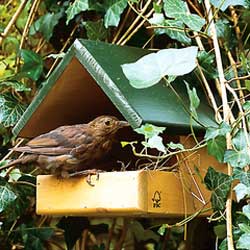
The robin and wren prefers to nest in an open fronted box, and our Robin and Wren Nest Box has been specifically designed with this in mind.
Equally suitable is the Open Birch Log Nest Box and is perfect if you prefer a more natural look.
These nest boxes should be located low to the ground, no more than 1m or so high, and will need to be well hidden by vegetation to keep predators away.

House Sparrow were once one of our commonest birds but populations have sharply declined in recent years, partly due to a lack of natural nesting sites.
House sparrows are very communal birds, typically nesting in colonies, so the Timber House Sparrow Terrace is perfect for them.

Inside the box is split into chambers to fit three pairs of birds – all very cosy! House sparrows are happy to use a nest box positioned high under the eaves, but when locating it remember to keep away from areas where house martins or swifts usually nest.
The Birch Log Hole Nest Box is suitable for tits and sparrows, and should be fixed at a height of between 2 and 4 metres.
Siting Your Nestbox
Birds like to have a clear flight path to the nest box so avoid too many obstacles that can make access difficult. It’s also a good idea to tilt the bird box downwards a little bit, then when it rains, the rain is more likely to hit the roof and not enter the nest box itself.
The nest box is best located away from strong, direct sunlight and strong winds, so unless it is in a sheltered corner position it so it is facing a north-easterly direction where possible.
Cleaning Your Nestboxes
Nestboxes should be cleaned well before the nesting season begins. Old nests can harbour disease and parasites so should be removed. Boiling water can be used to kill any remaining bugs and the box should then be left to dry out thoroughly before putting up in the garden.
The RSBP recommend that nestboxes should not inspected whilst birds are nesting, how ever tempting this might be. But you can keep an eye on everything that’s going on inside with the Nestbox with Infra Red Camera. Live footage taken during the day and night can then be viewed from your television!

…And to give birds a helping hand during the busy nesting season, don’t forget to provide water in a Bird Bath and some supplementary Bird Food on a Garden Bird Table.

Read Full Post »
Posted in Gardening at Home, Gardening at School, Wildlife, tagged bird feeders, bird food, bird tables, bird watching, blackbird, environmental education, feeding the birds, gardening, gardening for wildlife, gardening in school, gardening with children, grow your own, kids gardening, robin, School Projects, school wildlife, what to feed birds, wildlife education, wildlife gardening, wildlife project on January 13, 2010| 1 Comment »
Here at Gardening With Children, we care deeply about our environment as well as our wildlife, and during the winter months I have had such fun with my own children watching the birds in our garden.

Try Gourmet Robin Food in your garden and give this favourite bird a real treat
The children’s sheer delight as the drama of the bird world unfolds… The blue tits and great tits swapping and changing on the nut feeders, the blackbirds exploring the ground, the cautious wren hopping amongst the flower pots and the swooping in of the starlings – a boisterous mob of tear aways coming in and causing chaos… and that’s all in a few minutes!

The Niyger Bird Feeder is great for all sorts of seed feeding birds
…And yesterday I shared a joke with Jemima as we watched a pied wagtail perched on the wall. As it teetered and bobbed, wagging its tail to keep balance we soon saw where it got it’s name!!
Birds need our help more than ever at this time of year and we have also been feeding the birds at school. This provides a fantastic learning experience for the children, and handy feeders such as the Discovery Seed Feeder and the Window Bird Feeder can be placed where the children can see so much of the action from inside the classroom.

We also love the Handing Bird Table and the Ground Bird Table. Both are priced at just £13.95 and are made from FSC wood. Bird tables are important in any garden. They reduce the risk of hygiene problems, can be easily cleaned and they keep pets out of reach. They are also perfect for gardens where space is limited.

The full range of wildlife products, from for Hedgehog Food to Peanut Cakes and beautiful Birch Nesting Boxes, are all available at www.recycleworks.co.uk.

Read Full Post »